How to Choose the Right Marketplace for Your Business
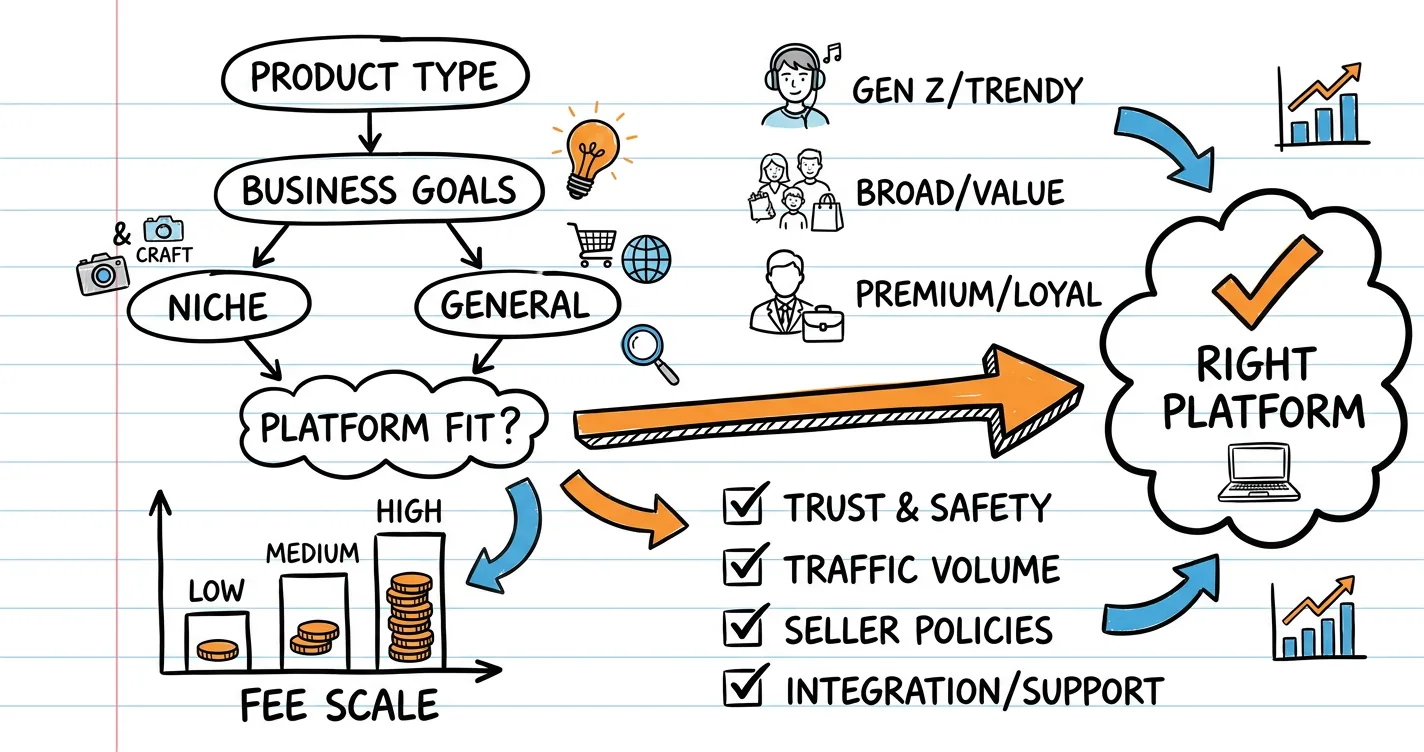
How to choose the right marketplace for your business comes down to four questions: What are you selling, who’s buying it there, what do the fees cost, and can you meet the fulfillment rules? In this guide, we walk through a practical framework for picking the right marketplace in 2026.
The Four Factors That Decide Your Marketplace
1. Category & Product Fit
Every marketplace has a sweet spot:
- Handmade / vintage → Etsy, Ruby Lane.
- Fashion & apparel → Poshmark, Mercari, Depop.
- New commodities / branded products → Amazon, Walmart, Shopify.
- Used goods, collectibles, auto parts → eBay.
- Quick local flips → Facebook Marketplace, OfferUp.
2. Fee Tolerance
Fees decide whether your margins survive. Model them before choosing:
| Marketplace | Effective Cost to Seller |
|---|---|
| eBid | ~5% |
| Bonanza | ~11% + $0.25 |
| Walmart Marketplace | 6–15% |
| eBay | ~13.5–15.5% |
| Amazon | 8–15% referral + Pro plan |
| Mercari | 10% |
| Facebook Marketplace | 5% (shipped) |
| Poshmark | 20% on sales over $15 |
A low-margin product that works on Walmart or eBid will die on Poshmark.
3. Dropshipping & Sourcing Rules
If you dropship, this is make-or-break:
- Amazon & Walmart require wholesale sourcing and prohibit retail packaging.
- eBay requires wholesale suppliers and prohibits sourcing from competing retail sites.
- eBay, Facebook, and Etsy are more flexible on fulfillment models.
4. Fulfillment Requirements
- Amazon & Walmart enforce strict 1–2 day handling and delivery speeds.
- eBay lets you set handling times up to 30 days — a huge advantage for dropshippers.
A Simple Decision Framework
Walk through these steps:
- List your products and margins.
- Shortlist marketplaces whose audience matches your category.
- Model fees + shipping + returns against your price point.
- Check the dropshipping rules if you source rather than hold stock.
- Start on one marketplace, master it, then expand.
Common Mistakes When Choosing
- Choosing by audience size alone — a huge marketplace with fees you can’t absorb is a loss.
- Ignoring dropshipping rules — account suspensions kill months of work.
- Spreading across five platforms at once — master one first.
- Skipping the fee model — the numbers are knowable; model them.
How to Compare Marketplaces Side by Side
A simple comparison table turns a gut decision into a math decision. For each shortlisted marketplace, fill in four columns:
| Factor | Your Product | Marketplace A | Marketplace B |
|---|---|---|---|
| Referral / final value fee | — | % of sale | % of sale |
| Payment processing | — | % + fixed | % + fixed |
| Shipping rules | — | Handling window | Handling window |
| Dropshipping allowed? | — | Yes/No | Yes/No |
Run the numbers for your average order value — a marketplace that looks cheap at first glance can be expensive once processing and ads are added.
When to Revisit Your Choice
Your marketplace isn’t a permanent decision. Re-evaluate when any of these change:
- Your margins shift — a fee increase or shipping-cost rise can flip a profitable channel.
- You add a new product line — the new category may fit a different marketplace better.
- A platform updates its rules — policy changes on dropshipping or fees happen regularly.
- You hit a growth plateau — the marketplace may be capping your reach, not your effort.
Review your channel mix at least quarterly, and always have a model of what each sale actually nets after fees.
Bottom Line
Choosing the right marketplace for your business is a four-factor decision: category fit, fees, dropshipping rules, and fulfillment. Start on the one platform that matches all four, then expand. If you’re evaluating eBay against alternatives, see our guide to pages similar to eBay and whether selling on eBay is worth it.
Frequently Asked Questions
How do I choose the right marketplace for my business?
Choose based on four factors: category fit, fee tolerance, dropshipping rules, and fulfillment requirements. Match your product type to a marketplace's audience, then check that your margins survive its fees.
What is the best marketplace for a new seller in 2026?
eBay and Facebook Marketplace have the lowest barriers to entry. Amazon and Walmart have the largest audiences but stricter requirements. Etsy is best for handmade, and Poshmark/Mercari for fashion and used goods.
Which marketplace has the lowest fees?
eBid charges 5%, Bonanza 11% + $0.25, and Facebook Marketplace is free for local sales. eBay's effective take rate is roughly 13.5–15.5%, and Poshmark charges 20% on sales over $15.
Chat with Agent PYRA
Tell Agent PYRA your niche and it finds winning products with real-time data: saturation scores, Google Trends, competitor ad performance, and AliExpress sourcing links. Stop scrolling spreadsheets and let AI do the research.
- Real-time saturation & trend analysis
- Cross-referenced Shopify, Amazon & Facebook Ads
- AliExpress & supplier source links
- Competitor ad creative & performance data
Start Finding Winning Products Today
Join thousands of dropshippers who use Pyratrend to spot trending products before they saturate the US market. Get 30 free credits when you sign up — no credit card required.
- Daily updated US-market product data
- Facebook Ad Library integration
- Shopify competitor store tracking
- Custom watchlists & alerts
Explore more how-to guides guides in the Pyratrend Insights hub, or check out today's trending products on our dashboard.