E-Commerce Development: A Complete Guide for 2026
E-commerce development is the full process of planning, designing, building, and launching an online store — from picking a platform to connecting payments and shipping. In this guide, we walk through what’s actually involved in 2026, how long it takes, and what it costs to build a US online store that converts.
What E-Commerce Development Includes
Development is much more than writing code. A complete project covers:
- Platform selection — hosted SaaS, open source, or fully custom.
- UX & design — storefront layout, product pages, and checkout flow.
- Frontend & backend build — the store, cart, payments, and admin systems.
- Integrations — payment gateways, shipping, email, accounting, and inventory.
- Launch & maintenance — testing, migration, performance tuning, and ongoing support.
Each of these is a phase of work with its own decisions — and they all live under the wider umbrella of ecommerce development solutions.
The Main E-Commerce Development Options
| Option | Best For | Typical Cost | Build Time |
|---|---|---|---|
| Shopify / BigCommerce | Fast, reliable launches | $39–$399/mo | 2–6 weeks |
| WooCommerce | Full control, content-heavy | $5–$100+/mo hosting | 3–8 weeks |
| Custom / agency build | Unique features & scale | $25k–$250k+ | 3–18 months |
| Headless / composable | Enterprise flexibility | $100k–$500k+ | 6–18 months |
Hosted platforms win on speed. Open source wins on control. Custom and headless win when your business model demands it. There’s no single best answer — only the right fit for your goals.
How the Development Process Works
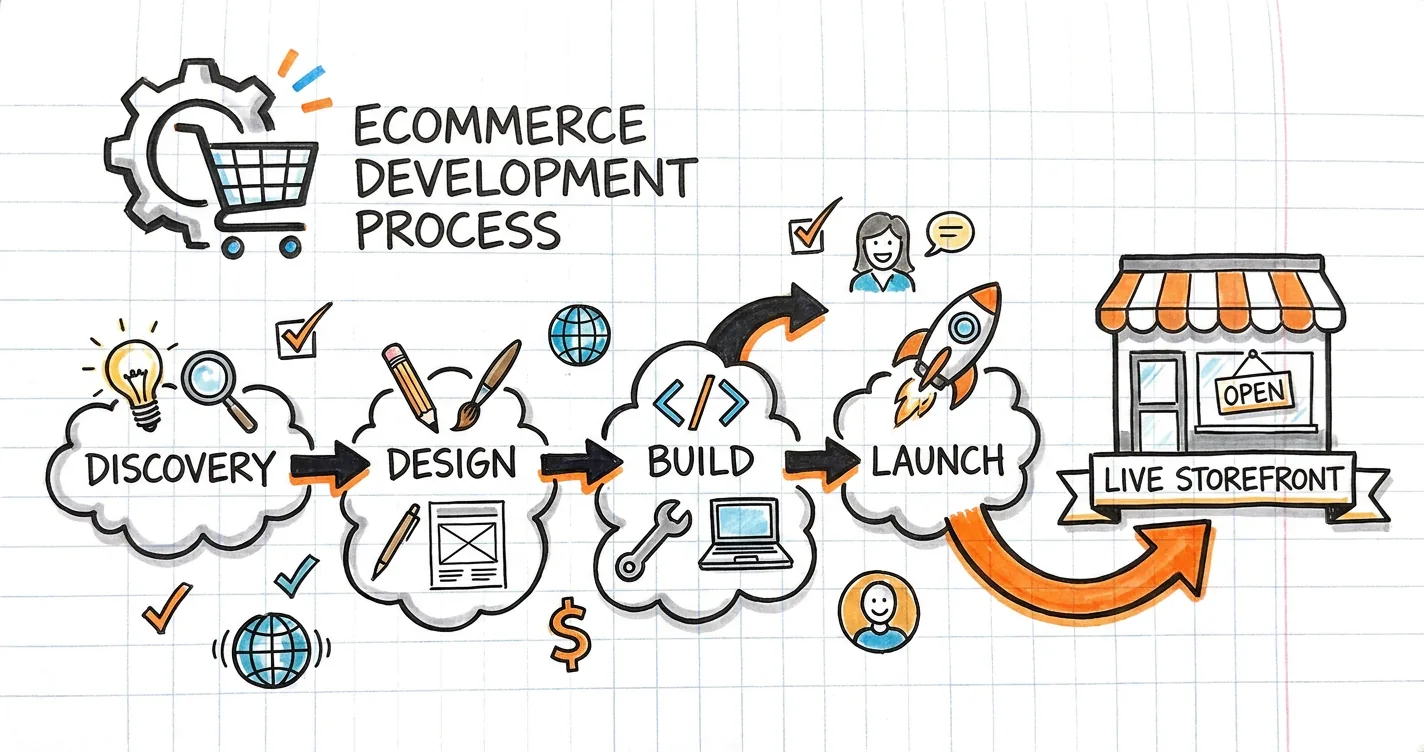
A standard build follows five phases, regardless of platform:
- Discovery — define goals, budget, and requirements.
- Design — map the customer journey and design the storefront.
- Development — build the store, cart, and integrations.
- Testing — QA, payment testing, and performance checks.
- Launch & optimize — go live, monitor, and iterate.
Key Decisions That Shape the Build
Three decisions determine most of your cost and timeline:
- Platform choice — the single biggest cost lever.
- Integration depth — ERP, CRM, and shipping systems add the most complexity.
- Custom vs. template — bespoke design multiplies both time and budget.
What It Costs to Build an Online Store
| Store Type | Cost Range |
|---|---|
| Template store, DIY | $2,000–$8,000 |
| Customized SMB build | $8,000–$25,000 |
| Mid-market custom build | $25,000–$60,000 |
| Enterprise build | $60,000–$150,000+ |
Hiring a dedicated ecommerce web design agency or a freelance ecommerce developer is the main cost driver beyond the platform itself.
How to Avoid Common Development Mistakes
- Skipping discovery — building without a defined scope is how budgets explode.
- Choosing a platform first — requirements should drive the platform, not the other way around.
- Ignoring integrations — payment, tax, and shipping failures kill launches.
- Forgetting mobile — roughly 68–72% of traffic and ~59% of global ecommerce sales are mobile, so mobile-first design is non-negotiable.
Bottom Line
E-commerce development is a multi-phase project that ranges from a two-week template launch to a six-month custom build — and the cost difference is the same scale. Define your requirements first, pick the platform that fits, and budget for integrations and launch. For a deeper look, read our custom ecommerce development guide and how to choose an ecommerce web design agency. And remember: the storefront is only half the equation — products with real ad demand behind them are what make it sell.
Frequently Asked Questions
What is e-commerce development?
E-commerce development is the process of planning, designing, building, and launching an online store — covering everything from platform selection and UX design to payment integration, hosting, and ongoing maintenance.
How long does e-commerce development take?
A platform store (Shopify, BigCommerce) typically takes 2–6 weeks to build. Custom or enterprise builds take 3–6 months, and headless architectures can take 6–18 months.
What are the main e-commerce development options?
The main options are hosted platforms like Shopify or BigCommerce, open-source options like WooCommerce, and fully custom or headless builds. Each trades cost and control against speed.
Chat with Agent PYRA
Tell Agent PYRA your niche and it finds winning products with real-time data: saturation scores, Google Trends, competitor ad performance, and AliExpress sourcing links. Stop scrolling spreadsheets and let AI do the research.
- Real-time saturation & trend analysis
- Cross-referenced Shopify, Amazon & Facebook Ads
- AliExpress & supplier source links
- Competitor ad creative & performance data
Start Finding Winning Products Today
Join thousands of dropshippers who use Pyratrend to spot trending products before they saturate the US market. Get 30 free credits when you sign up — no credit card required.
- Daily updated US-market product data
- Facebook Ad Library integration
- Shopify competitor store tracking
- Custom watchlists & alerts
Explore more ecommerce guides in the Pyratrend Insights hub, or check out today's trending products on our dashboard.