

Ecom Websites: What They Are & How to Build One (2026)
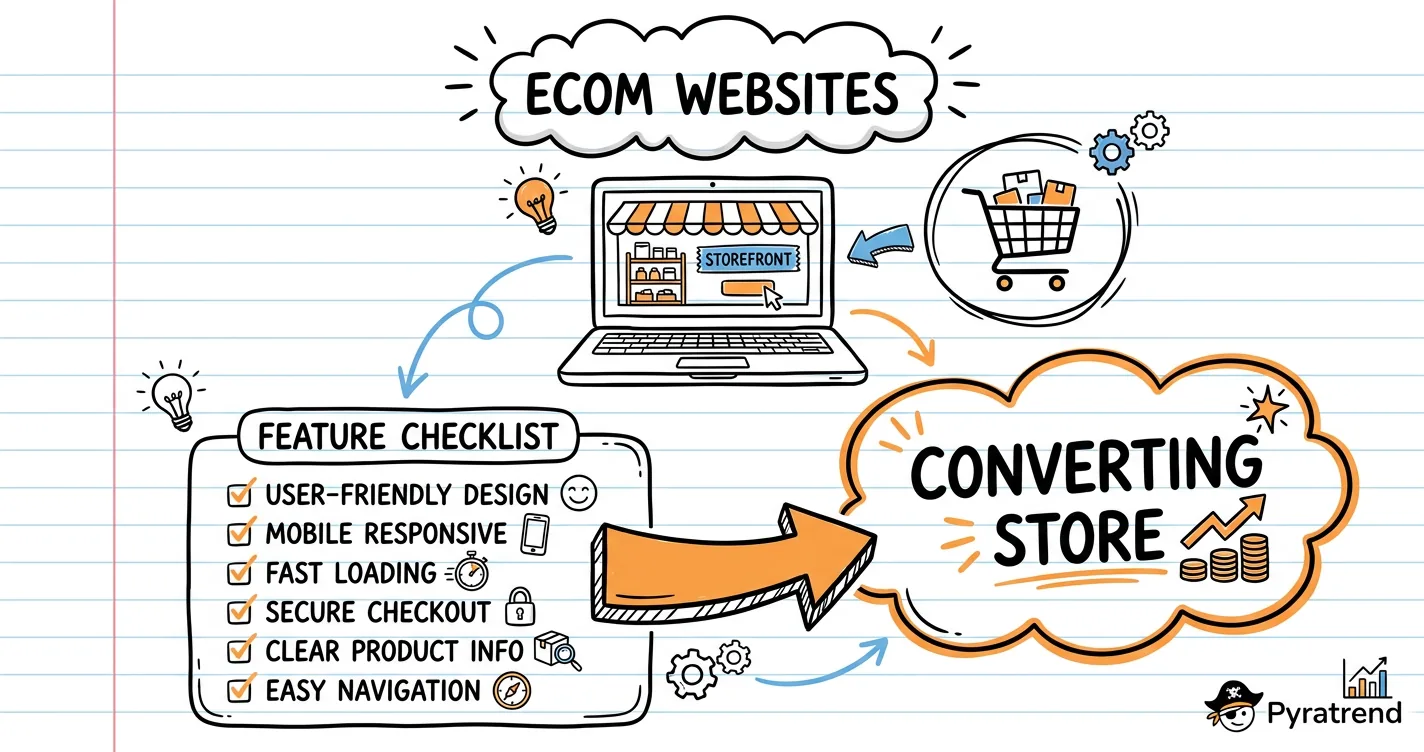
Ecom websites are online stores that sell products or services over the internet, process payments, and handle order fulfillment — “ecom” simply being the industry’s shorthand for ecommerce. US retail ecommerce passed $1.19 trillion in 2025 (roughly 16.4% of total US retail), which is why a well-built e-commerce website is now the default storefront for a US business. This guide covers what makes a good ecom website, the best examples to model, and the exact build steps.
What Is an Ecom Website?
An ecom website is any site with a working purchase loop: product pages → cart → checkout → order confirmation. Everything else — design, content, marketing — supports that loop.
The bare minimum every ecom site needs:
- Product catalog with photos, descriptions, and prices.
- Cart and secure checkout (Stripe, PayPal, Shopify Payments and similar).
- Order fulfillment (stock sync, shipping rates, tracking).
- Trust signals (reviews, return policy, contact page).
What Makes a Great Ecom Website
The sites that win in 2026 do four things well:
- Fast storefront — pages load in under 2.5s LCP; slow sites lose conversions.
- Mobile-first layout — over half of US traffic is mobile.
- Clear product messaging — a headline, a price, and a reason to buy now.
- Frictionless checkout — guest checkout, saved cards, Apple/Google Pay.
The Features Table Buyers Notice
| Feature | Why It Matters | Must-Have? |
|---|---|---|
| Fast page speed | Keeps bounce rate down | Yes |
| Mobile checkout | Captures phone shoppers | Yes |
| Product reviews | Builds trust and lifts CVR | Yes |
| Search + filters | Helps big catalogs convert | For 50+ SKUs |
| Abandoned cart email | Recovers ~10–15% of lost carts | Recommended |
| Clear shipping info | Reduces cart abandonment | Yes |
Best Ecom Website Examples to Model
These are the US sites everyone benchmarks against — and what to copy from them:
- Amazon — ~$447–$492 billion in US online sales in 2025 (~38–40% of US ecommerce). Copy the product page density: reviews, images, and an unmissable buy box.
- Walmart — ~$76–$94 billion. Copy the omnichannel trust: pickup, delivery windows, and simple assortment.
- Apple — ~$41–$43 billion. Copy the premium product storytelling.
- eBay — ~$33–$36 billion. Copy seller trust mechanics: feedback and clearly stated shipping.
- DTC benchmarks — Warby Parker, Allbirds, Glossier, and Gymshark show how a brand story + clean catalog converts for smaller players. Together, Shopify merchants already move over 10% of total US ecommerce GMV.
How to Build an Ecom Website in 2026
- Pick a platform — hosted (Shopify, BigCommerce, Wix, Squarespace) or open-source (WooCommerce).
- Design the catalog — 5–20 strong products beat a thin mega-store.
- Set up payments + shipping — US defaults: Stripe/PayPal-style gateways, USPS/FedEx/UPS rates.
- Add trust pages — policies, contact, about; these matter to US buyers.
- Choose a theme that’s fast — lighter themes rank better on Core Web Vitals.
- Launch and iterate — watch add-to-cart and checkout abandonment, then fix the weakest step.
For a lean start, a $29–$39/month hosted plan is enough — most sellers who fail ecommerce fail on product-market fit, not on platform features.
Common Ecom Website Mistakes
- Slow theme — a heavy homepage tanks both SEO and conversion.
- Hidden shipping costs — surprise shipping at checkout is the #1 US abandonment cause.
- No reviews — US shoppers expect social proof on every product.
- Ignoring mobile — desktop-only design quietly loses half your traffic.
What the Best Ecom Websites Have in Common
Regardless of niche, winners keep the loop tight: clear offer, fast page, honest shipping, obvious trust. Copy those habits from Amazon, Walmart, and the top DTC brands — not their scale.
Bottom Line
Ecom websites are purpose-built online stores, and with US ecommerce above $1.19 trillion in 2025, the opportunity is real at every size. Copy the trust and clarity of the biggest names, launch lean on a hosted plan, and improve one step of the funnel each week. To go deeper on the options, read about the best ecommerce websites to model, the best web ecommerce platforms, understand b2c ecommerce versus b2b ecommerce solution, and settle the ecommerce or e-commerce spelling question once and for all. Whether you are an established store or just starting out, you can spot what to sell next on our live trending products page.
Frequently Asked Questions
What is an ecom website?
An ecom website is an online store that sells products or services over the internet, processes payments, and handles order fulfillment. 'Ecom' is the industry shorthand for ecommerce, and it is standard US business jargon.
How much does it cost to build an ecom website?
Hosted builders like Shopify, BigCommerce, or Wix cost $29–$399/month plus apps. Custom builds start around $3,000–$10,000 for design and development. Running costs rarely exceed $200/month on a starter plan.
How big is US ecommerce in 2026?
US retail ecommerce surpassed $1.19 trillion in 2025 — about 16.4% of total retail sales, closer to 23% of addressable online-eligible retail — and keeps growing year over year.
Chat with Agent PYRA
Tell Agent PYRA your niche and it finds winning products with real-time data: saturation scores, Google Trends, competitor ad performance, and AliExpress sourcing links. Stop scrolling spreadsheets and let AI do the research.
- Real-time saturation & trend analysis
- Cross-referenced Shopify, Amazon & Facebook Ads
- AliExpress & supplier source links
- Competitor ad creative & performance data
Start Finding Winning Products Today
Join thousands of dropshippers who use Pyratrend to spot trending products before they saturate the US market. Get 30 free credits when you sign up — no credit card required.
- Daily updated US-market product data
- Facebook Ad Library integration
- Shopify competitor store tracking
- Custom watchlists & alerts
Explore more ecommerce guides in the Pyratrend Insights hub, or check out today's trending products on our dashboard.