Ecommerce SEO Tips: The 2026 Playbook for US Stores
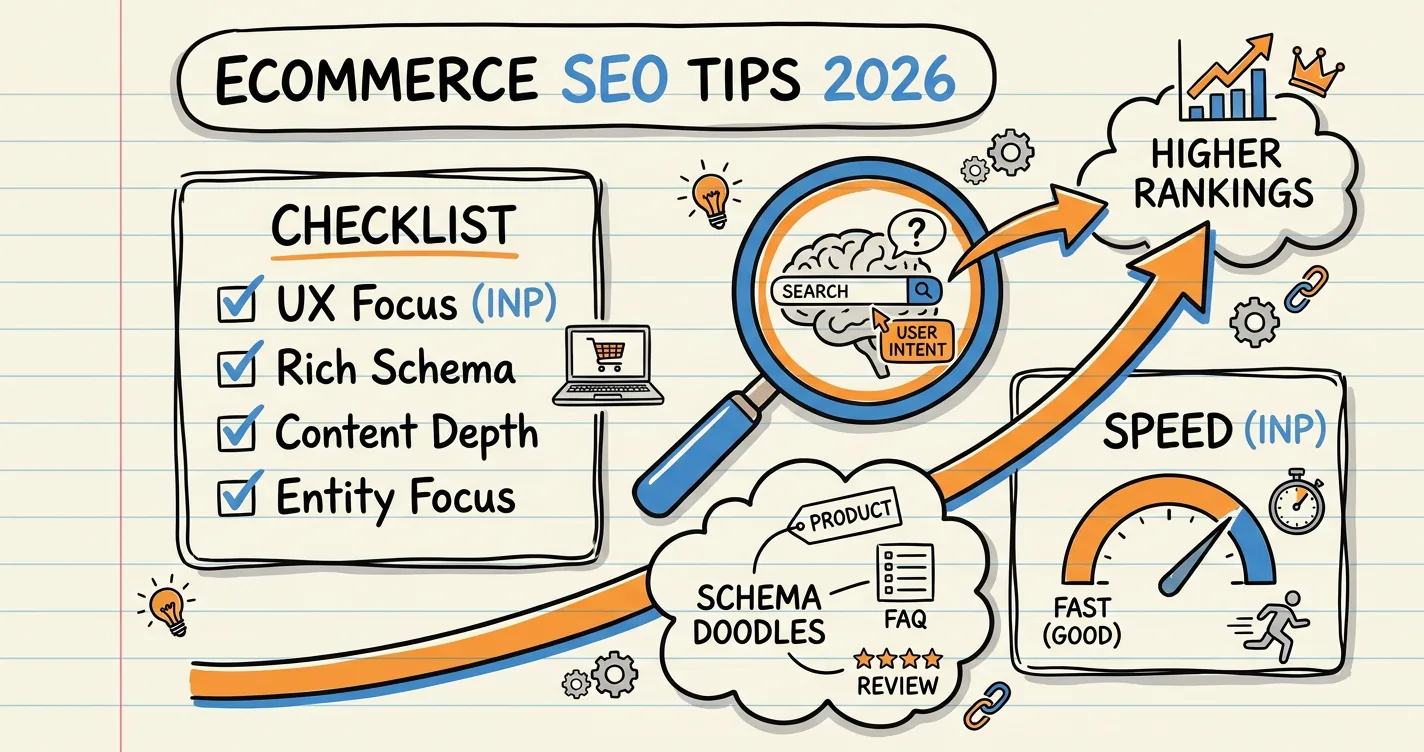
Ecommerce SEO tips are the tactical moves that get product and category pages ranking — and it matters because organic search drives about 53% of web traffic and 31–40% of ecommerce revenue. In this playbook, we cover the 2026 ecommerce SEO tactics that actually move rankings for US stores.
Why Ecommerce SEO Matters More Than Ever
The 2026 landscape has shifted:
- Organic search drives 31–40% of ecommerce revenue.
- 60–68% of US searches end without a click — AI Overviews and SERP features capture demand.
- SEO ROI is strong — the median program returns about $7.48 per $1 spent.
The store that wins is the one Google (and AI) can read, crawl, and trust.
The 2026 Ecommerce SEO Playbook
1. Control Faceted-Navigation Crawl Traps
Filters (color, size, price) can generate millions of duplicate URLs that waste crawl budget. Configure them with noindex, follow tags, robots.txt disallows, or canonical tags pointing to the main category URL.
2. Optimize for INP (Interaction to Next Paint)
INP replaced FID as a Core Web Vital — threshold is ≤ 200ms. Minimize heavy JavaScript on filters, search bars, and “Add to Cart” interactions, and debounce inputs.
3. Structure Data for AI Overviews
Google’s AI Overviews cite clear, semantic content. Format product specs (dimensions, materials, compatibility, pricing) as tables and FAQ lists. Add Product, Offer, and AggregateRating schema.
4. Target Long-Tail Commercial Keywords
Rank for specific queries like “hypoallergenic waterproof mattress protector queen” instead of broad, impossible terms. Long-tails convert and are winnable.
5. Build Contextual Internal Links
Link from blog content to high-margin category pages with descriptive anchors. Add related-product and frequently-bought-together modules.
The Core Web Vitals Benchmarks
| Metric | Threshold |
|---|---|
| LCP (loading) | ≤ 2.5s |
| INP (interactivity) | ≤ 200ms |
| CLS (visual stability) | ≤ 0.1 |
Evaluate at the 75th percentile of real-world visits — test on mobile, not just desktop.
Common Ecommerce SEO Mistakes in 2026
- Faceted-navigation crawl traps — millions of filter URLs diluting link equity.
- Copied manufacturer copy — thin, duplicate content gets filtered.
- Deleting out-of-stock pages — 404 instead of 301 or OutOfStock schema.
- Stale structured data — wrong price or availability drops rich results.
- Uncompressed media — multi-megabyte images fail Core Web Vitals.
How to Execute Ecommerce SEO
- Run a technical audit — crawl the site, fix faceted navigation and speed.
- Choose an SEO-friendly platform — see our best seo ecommerce platform comparison.
- Build structured data — product, review, and breadcrumb schema.
- Create content that ranks — guides that link to money pages.
- Measure and iterate — track rankings, clicks, and revenue.
Bottom Line
Ecommerce SEO tips that work in 2026 center on crawl control, INP-speed, structured data, and long-tail keywords — because AI Overviews now capture most clicks. Fix the technical foundations, structure data for AI citation, and build a search engine friendly ecommerce store that Google can trust. The platforms and comparison in best ecommerce for seo will point you to the right foundation.
Frequently Asked Questions
What are the best ecommerce SEO tips for 2026?
The best 2026 ecommerce SEO tips are: control faceted-navigation crawl traps, optimize for INP as a Core Web Vital, format product specs for AI Overviews, target long-tail commercial keywords, and build contextual internal links.
How much traffic does ecommerce SEO drive?
Organic search drives about 53% of all web traffic and 31–40% of ecommerce revenue. A strong SEO program returns roughly $7.48 for every $1 spent.
What is the most important ecommerce SEO ranking factor?
There's no single factor, but Core Web Vitals (LCP ≤ 2.5s, INP ≤ 200ms, CLS ≤ 0.1), structured data, and crawl control over faceted navigation consistently separate ranking stores from the rest.
Chat with Agent PYRA
Tell Agent PYRA your niche and it finds winning products with real-time data: saturation scores, Google Trends, competitor ad performance, and AliExpress sourcing links. Stop scrolling spreadsheets and let AI do the research.
- Real-time saturation & trend analysis
- Cross-referenced Shopify, Amazon & Facebook Ads
- AliExpress & supplier source links
- Competitor ad creative & performance data
Start Finding Winning Products Today
Join thousands of dropshippers who use Pyratrend to spot trending products before they saturate the US market. Get 30 free credits when you sign up — no credit card required.
- Daily updated US-market product data
- Facebook Ad Library integration
- Shopify competitor store tracking
- Custom watchlists & alerts
Explore more ecommerce guides in the Pyratrend Insights hub, or check out today's trending products on our dashboard.