

Search Engine Friendly Ecommerce: Build a Site Google Loves
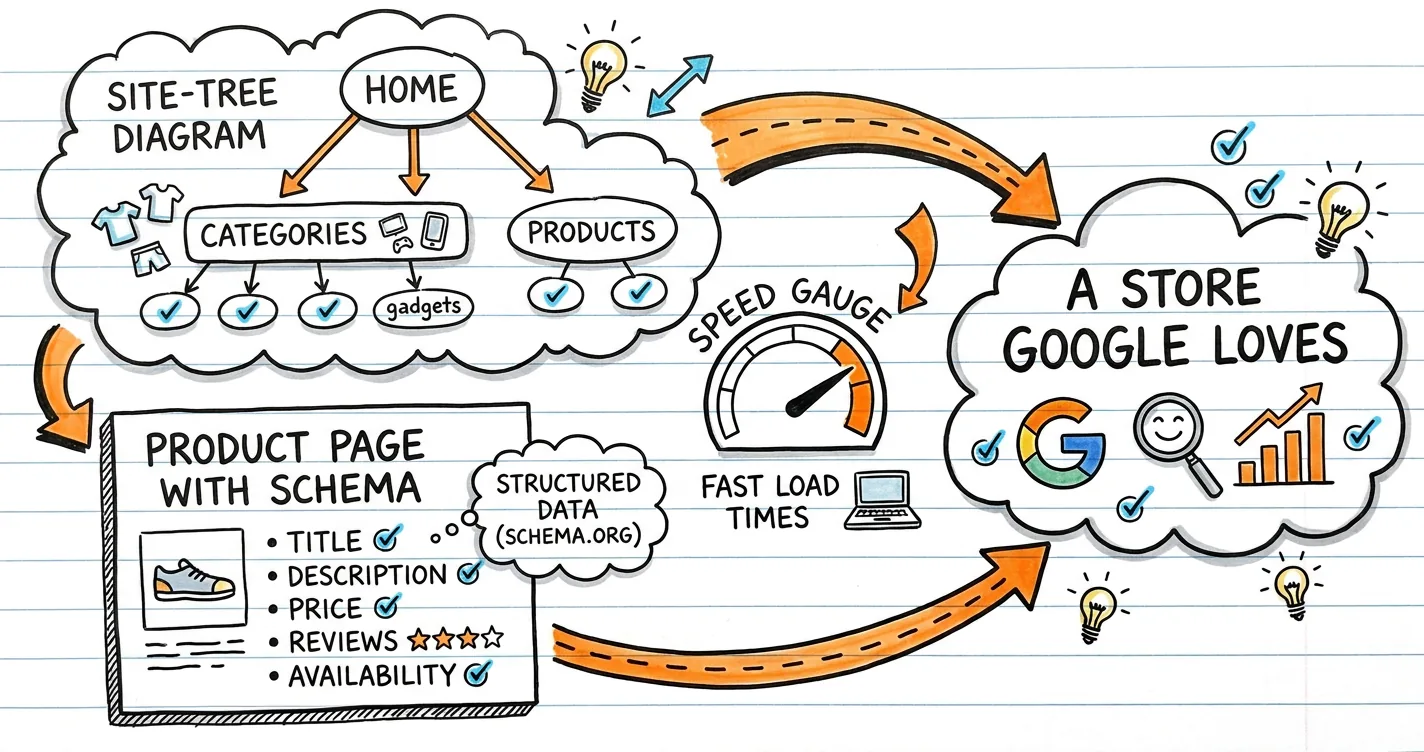
Search engine friendly ecommerce is a website Google can crawl, index, and understand with minimal friction — clean URLs, unique product copy, structured data, and fast page speed. It matters because organic search drives about 53% of web traffic and 31–40% of ecommerce revenue. This guide shows you how to build one in 2026.
The Anatomy of a Search Engine Friendly Ecommerce Site
1. Clean URL Structure
Use readable, static URLs — brand.com/mens-shoes/trail-runner — not parameter strings like brand.com/?p=9843&cat=2.
2. Optimized Product Pages
Every product page needs:
- Keyword-targeted H1 with the product name.
- Unique product copy — never paste raw manufacturer descriptions.
- Optimized title and meta tags.
- WebP/AVIF images with descriptive alt text.
- Product schema — Offer (price, currency, availability), AggregateRating, Review.
3. Category Pages That Convert
Add 100–300 words of informative intro and footer copy targeting parent keywords, dynamic H1s, and indexation controls on faceted filters to prevent duplicate content.
4. Structured Data (JSON-LD)
Implement Product, Offer, AggregateRating, Review, BreadcrumbList, and Organization schema sitewide. This feeds both Google rich results and AI Overviews.
5. Fast Page Speed
- TTFB under 800ms.
- Minimal render-blocking JavaScript.
- Lazy loading for below-the-fold images.
- CDN delivery.
- Core Web Vitals at LCP ≤ 2.5s, INP ≤ 200ms, CLS ≤ 0.1.
6. Flat Site Architecture
Every product should be reachable within 3 clicks of the homepage: Home > Category > Subcategory > Product, reinforced by breadcrumbs.
Why These Elements Matter in 2026
- AI Overviews cite structured content — tables, specs, and FAQs are more citable.
- 60–68% of US searches end without a click — rich results are the only visibility.
- INP replaced FID — interaction speed now affects rankings.
Common Mistakes That Break SEO Friendliness
- Faceted-navigation crawl traps — filter URLs inflating the index.
- Manufacturer copy verbatim — thin duplicate content.
- 404s on discontinued products — keep them live with OutOfStock schema or 301.
- Stale schema — wrong price or availability drops rich results.
- Huge images — failing Core Web Vitals on mobile.
How to Audit Your Store’s SEO Friendliness
Run a simple audit before you invest in fixes. Google each of your top 10 product pages and check:
- Is the URL clean? Static and readable beats long parameter strings.
- Is the title unique? No auto-generated, duplicated titles.
- Does the page have schema? Product and breadcrumb markup present?
- Is it fast on mobile? Test on a real phone, not just desktop.
Then use a crawler to check index coverage — pages Google chose not to index often reveal crawl or duplicate-content problems you can’t see manually.
How to Make Your Ecommerce Site Search Engine Friendly
- Pick an SEO-capable platform — compare options in best seo ecommerce platform.
- Audit URLs, schema, and speed — fix the technical foundations first.
- Write unique product copy — original descriptions and specs.
- Implement JSON-LD sitewide — product, review, breadcrumb schema.
- Build a flat, breadcrumbed structure — every page 3 clicks from home.
- Keep the site fast — compress media, cut JavaScript, use a CDN.
Bottom Line
A search engine friendly ecommerce site is crawlable, indexable, and structured — clean URLs, unique copy, JSON-LD, fast Core Web Vitals, and a flat architecture. In 2026, structured data also feeds AI Overviews, so schema is a ranking lever, not a nice-to-have. Apply the full ecommerce seo tips playbook and you’ll have a store Google — and AI — can trust.
Frequently Asked Questions
What is a search engine friendly ecommerce website?
A search engine friendly ecommerce website is easy for Google to crawl, index, and understand — with clean URLs, unique product copy, structured data, fast page speed, and a flat site architecture.
What are the key SEO elements of an ecommerce product page?
The key elements are a keyword-targeted H1, unique product descriptions, optimized title and meta tags, compressed WebP images with descriptive alt text, and Product schema markup with price and availability.
What is the best site structure for ecommerce SEO?
A flat hierarchy: every product reachable within 3 clicks from the homepage (Home > Category > Subcategory > Product), supported by breadcrumbs and contextual internal links.
Chat with Agent PYRA
Tell Agent PYRA your niche and it finds winning products with real-time data: saturation scores, Google Trends, competitor ad performance, and AliExpress sourcing links. Stop scrolling spreadsheets and let AI do the research.
- Real-time saturation & trend analysis
- Cross-referenced Shopify, Amazon & Facebook Ads
- AliExpress & supplier source links
- Competitor ad creative & performance data
Start Finding Winning Products Today
Join thousands of dropshippers who use Pyratrend to spot trending products before they saturate the US market. Get 30 free credits when you sign up — no credit card required.
- Daily updated US-market product data
- Facebook Ad Library integration
- Shopify competitor store tracking
- Custom watchlists & alerts
Explore more ecommerce guides in the Pyratrend Insights hub, or check out today's trending products on our dashboard.